Research
Some of the topics my collaborators and I have been working on.
Atomic-scale Mechanisms of Hydrogen Embrittlement: A Phase-Field Crystal Study
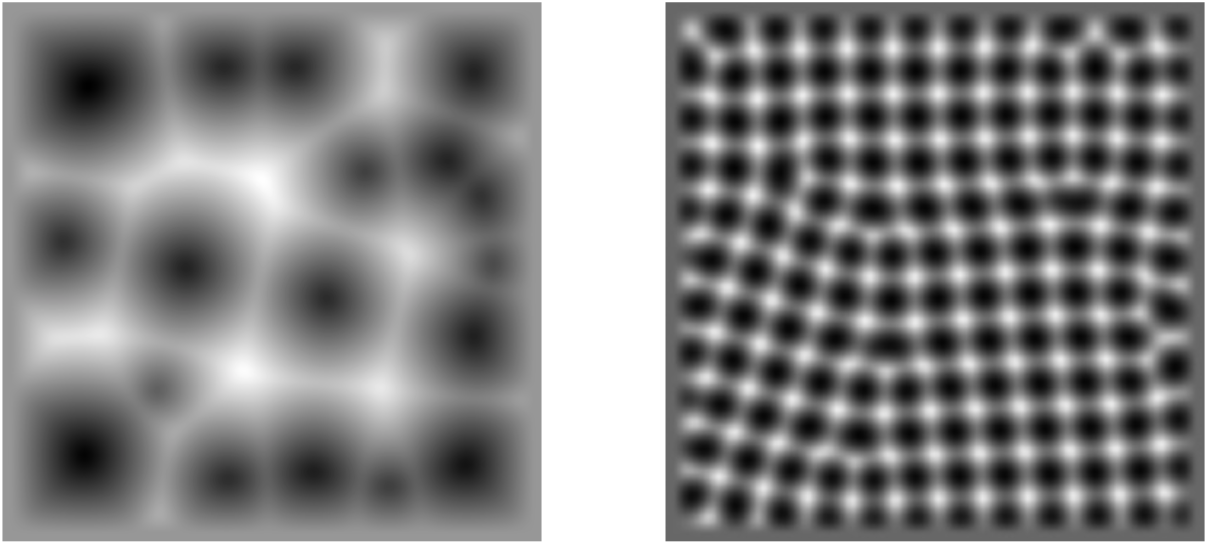
Hydrogen embrittlement (HE) triggers a profound loss of ductility in metals, and an unified framework bridging atomic-scale hydrogen–defect interactions with established mesoscale mechanisms remains elusive. We address this by extending the Vapor-forming Structural Phase-Field Crystal (VXPFC) model [Phys. Rev. Mater. 8, 093402 (2024)] to a binary metal–hydrogen system. We demonstrate that three-particle interactions are essential to capture the elastic response of Cottrell atmospheres and the concurrent mechanisms of hydrogen absorption and grain boundary segregation. By quantifying the temperature-dependent stress response of the metal–hydrogen system under uniaxial tension, we provide a mechanistic basis for elucidating the dual hardening and softening effects of hydrogen on the host metal. [TMS2025 Poster]
Multicomponent of Interstitial Lattices with PFC
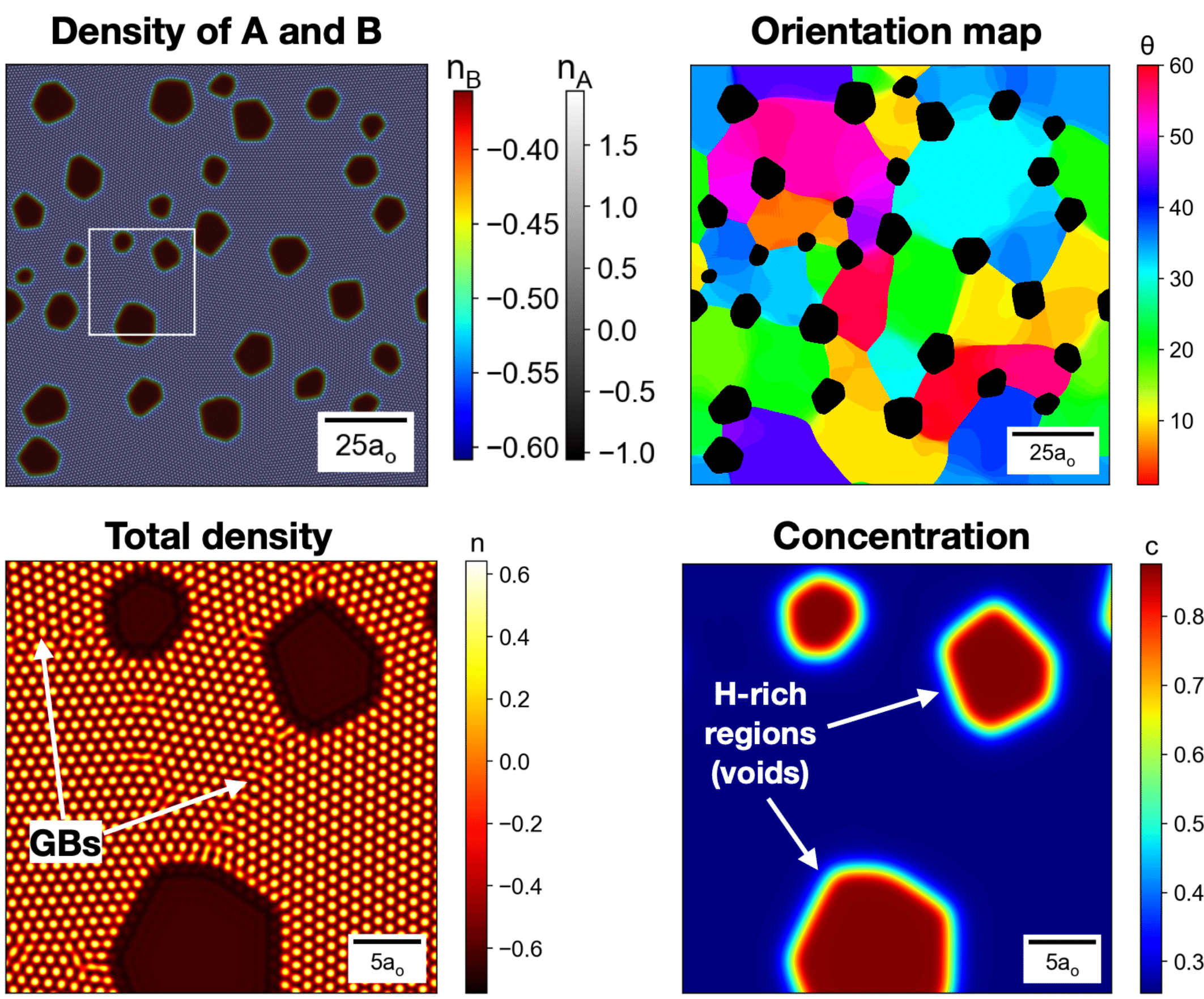
Single crystal coexistence with liquid simulated with a two-component interstitial PFC model in 2D. B atoms (solute) site at interstitial sites of a triangular crystal lattice of A atoms (host). [More]
PFC models for vapour-liquid-solid coexistence and transitions
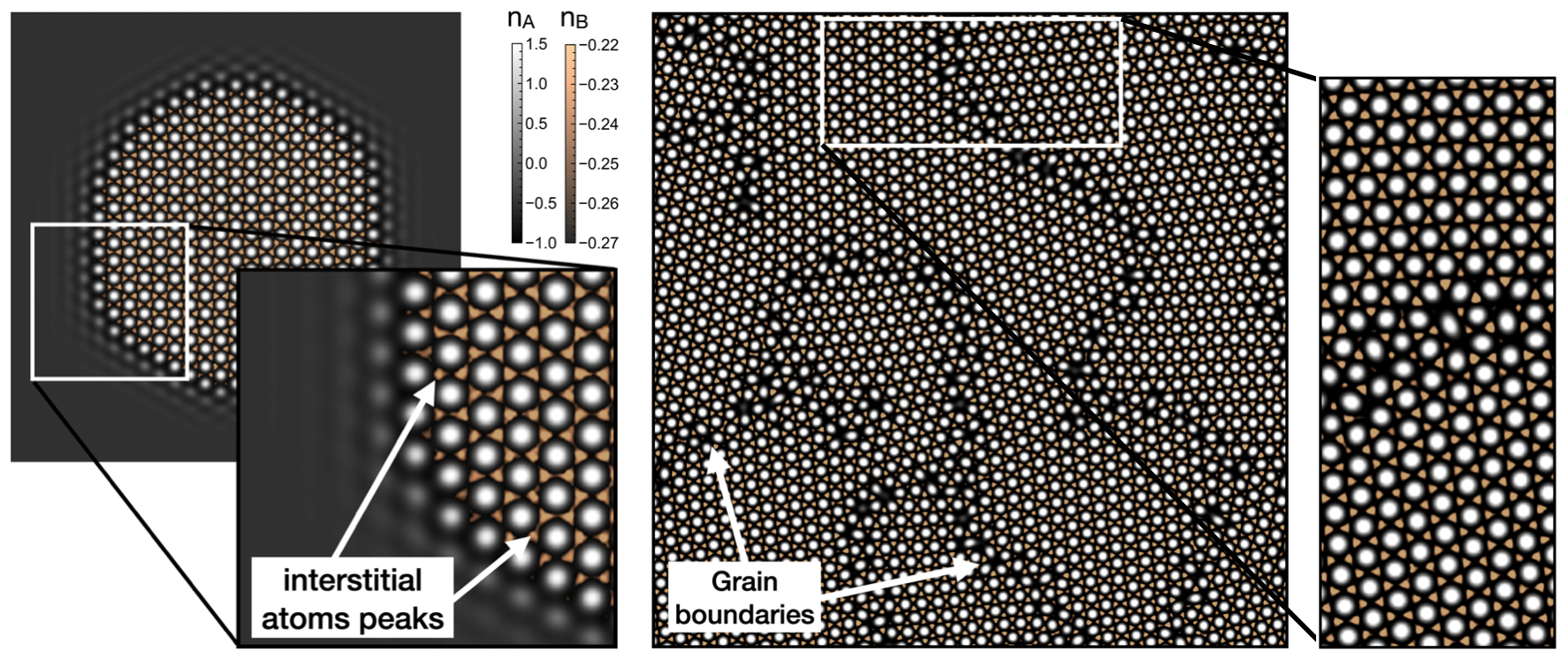
A new phase field crystal (PFC) type theory is presented, which accounts for the full spectrum of solid-liquid-vapor phase transitions within the framework of a single density order parameter. [more]
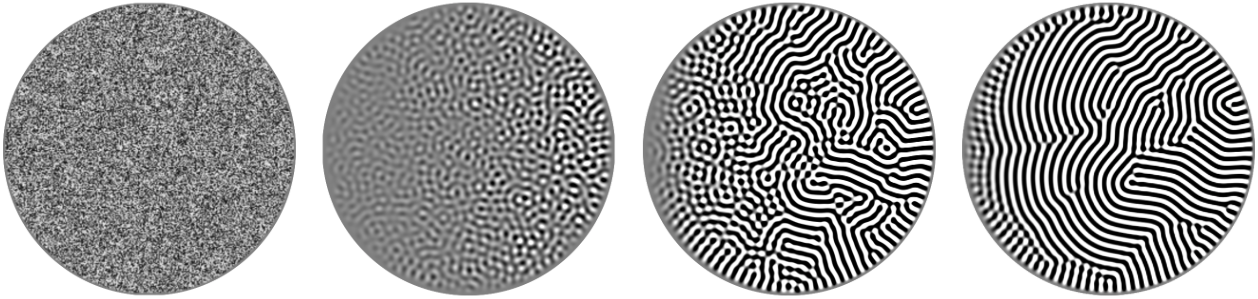
Nonuniform forcing and stripe orientation in Swift-Hohenberg dynamics
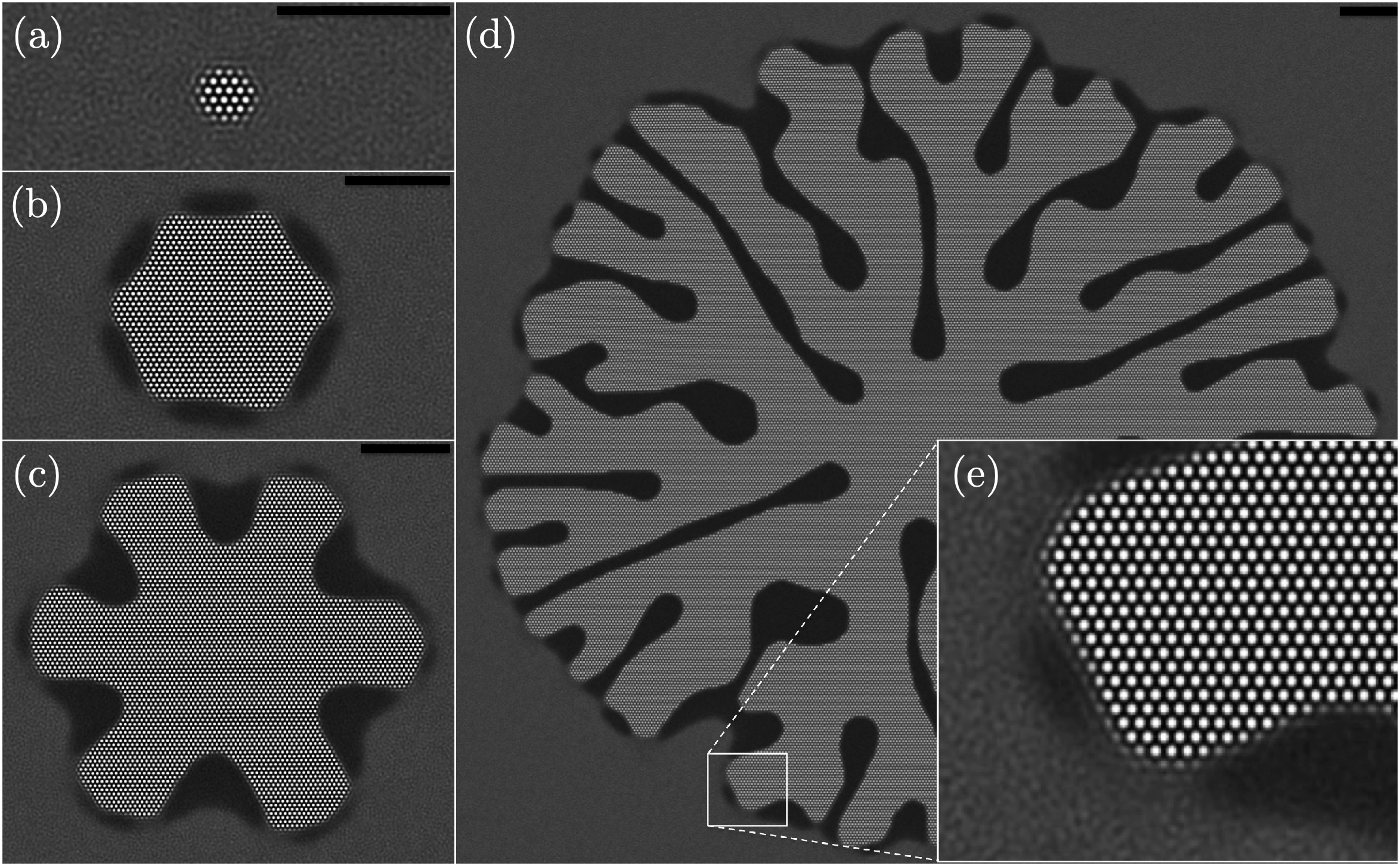
Gradients of the bifurcation parameter can induce stripe orientation in the Swift-Hohenberg dynamics. However, they face competition from boundary, bulk and geometric effects, and pattern alignment becomes an intricate question. [more]

Ramped Rayleigh-Bénard systems in circular geometries
Several numerical works consider regular geometries when studying temperature gradients across a Rayleigh-Bénard convection cell. A numerical approach based on a finite-difference scheme is proposed for studying such system in a circular geometry maintaining second-order accuracy at the boundary conditions. [more]
Pattern formation in the Bénard-Marangoni convection
Bénard-Marangoni convection exhibits square, hexagonal, and other peculiar patterns that can be modeled by the Knobloch equation. This fourth-order nonlinear evolution equation is derived via the multiple scales formalism and reproduces the main features of the phenomena observed in experimental setups. [more]